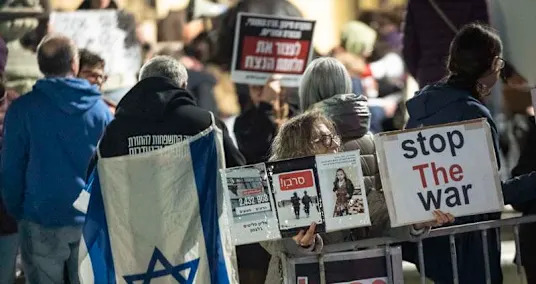
Demonstrators carried signs reading “We must stop” and “Bibi will kill us all,” while about 200 people gathered at Horev Junction in Haifa.
Anti-war demonstrations were held across Israel on Saturday evening, with protesters gathering in Tel Aviv, Haifa, Jerusalem, and Kfar Saba despite strict wartime restrictions on public assembly.
Demonstrators carried signs reading “We must stop” and “Bibi will kill us all,” while about 200 people gathered at Horev Junction in Haifa.
Earlier on Saturday, the Home Front Command granted an exceptional permit for a protest of up to 150 people at Habima Square in Tel Aviv, after state authorities told the High Court of Justice that demonstrations would be allowed only in a limited format and under tight attendance caps.
The Association for Civil Rights in Israel sought an urgent hearing, arguing that the restrictions harm the right to protest.

Security restrictions and court dispute
One IDF officer said the Home Front Command examined each requested protest site individually on operational, professional, and security grounds, including proximity to protected spaces. As a result, authorities did not approve a large gathering at Habima Square and instead allowed only 50 to 150 participants near a shelter.
The officer said the military declined to provide further details on all of its security considerations, but offered to present them to the court in a closed session.
“We are acting professionally and objectively. There is no political consideration here or any other consideration,” he said.
The requests covered several locations, including Habima Square in Tel Aviv, Horev Center in Haifa, Paris Square in Jerusalem, and Weizmann Street in Kfar Saba. In Tel Aviv, the state told the Supreme Court that the protest could proceed in two separate groups of up to 75 people each, for a total of 150 participants.
Protest groups push back
Police and the Home Front Command said the limits stemmed from operational and security concerns, against the backdrop of fears of missile fire and broader wartime restrictions on gatherings.
Civil rights lawyers, however, argued in court that earlier judicial remarks on the importance of political free expression during wartime had not been meaningfully implemented.
The dispute followed a tense High Court hearing on Friday, during which Supreme Court President Isaac Amit sharply criticized the state’s position.
The judges stressed that the right to protest does not disappear during war and said police should propose a framework that would allow demonstrations to proceed.
latest_posts
- 1
 Dwayne ‘the Rock’ Johnson opens up about being the 'new guy' again — and why this moment feels like a new life
 - 2Getting breast implants was a mistake I live with every day. Why I’m sharing my story now, at 70, in pain and afraid.
- 3Vote In favor of Your Favored Web-based Venture Stage
- 4Cocoa Prices Sink on Favorable Crop Conditions in West Africa
- 5Knesset FADC extends emergency draft for 280,000 IDF reservists until January 1


- Mother and Stepson Rescued After Being Swept Over 6 Miles in Paddleboarding Mishap
- Qatar LNG Ships U-Turn After Attempt to Pass Through Hormuz
- Pick Your Favored kind of books
- ‘Everybody Loves Raymond: 30th Anniversary Reunion’ premiere date: How to watch, channel, time, cast and more
- Commonsense Ways to work on Your Funds with a Restricted Pay
- How do my eyes adjust to the dark and how long does it take?
- Public mistrust linked to drop in deceased donor organ donations and kidney transplants
- A Manual for Nations to Head out To
- The most effective method to Guarantee Simple Availability in Seniors' SUVs


